Showing posts with label Science. Show all posts

Friday, November 07, 2025

Nonfiction November, Week 2 - Choosing Nonfiction


This week's host is Frances at Volatile Reader blog.

The topic is Choosing Nonfiction: There are many topics to choose from when looking for a nonfiction book.  For example:  Biography, Autobiography, Memoir, Travel, Health, Politics, History, Religion and Spirituality, Science, Art, Medicine, Gardening, Food, Business, Education, Music.  Maybe use this week to challenge yourself to pick a genre you wouldn’t normally read? Or stick to what you usually like is also fine.  If you are a nonfiction genre newbie, did your choice encourage you to read more?

I have to admit that when it comes to nonfiction, I don't often go outside my favorite types: memoir, outdoors/nature, travel, health, and a sprinkling of history.


My current nonfiction on audio is squarely inside my comfort zone, but it's a genre I rarely read: science. I'm thoroughly enjoying listening to Gulp: Adventures on the Alimentary Canal by Mary Roach. I've been meaning to read one of her books for many years, and I'm so glad I finally got to it. It's absolutely fascinating, hilariously laugh-out-loud funny, and really gross. My husband heard me laughing while I was cooking dinner while camping this week (he was outside grilling), and when he came in for dinner, he asked what was so funny. So I told him, as he looked at me open-mouthed and said, "We're eating dinner!" He has forbid me from sharing any more of the book with him. ha ha


What kinds of nonfiction do you prefer to read?

Can you remember a time when you tried something different? Did you enjoy it?

Let me know in the comments below! 

Friday, December 08, 2023

Nonfiction Review: The Zookeeper's Wife

Way back in 2007 when The Zookeeper's Wife by Diane Ackerman was first released, I heard scores of rave reviews, so I added it to my want-to-read list (a very long list). Fast-forward to 2022 when I was visiting Little Free Libraries in my town--supposed to be just dropping off--and I spotted the book and snatched it up. I finally read it last month for Nonfiction November. Wow, what a stunning book! It was definitely worth the wait.

The book opens in 1935 in Poland, describing the beautiful world of the Warsaw Zoo, run by husband and wife Jan and Antonina Zabinski. Their zoo was filled with unique and fascinating animals in realistic habitats, with a large collection of exotic birds, reptiles and amphibians, animals from around the world, and animals unique to their region, like the European bison (I never knew there was such a thing!) and Przywalski horses. Their large, modern house on the premises was filled with a strange menagerie of baby or injured animals being nursed back to health, many of whom became family pets, beloved by their young son, Ryszard. It was a peaceful, harmonious, lovely place. Then in 1939, they woke one morning to the sounds of German warplanes, followed by weeks of bombs directly hitting the city--and the zoo--and soon, the Nazis marching in to invade in September 1939. The Nazis walled off a Jewish ghetto and began their process of restricting, then later ending their lives. The animals still left in the zoo, those not killed or run off by the bombing, were taken by a colleague of theirs, a German zookeeper they had previously been friends with and with whom they enjoyed discussing zoology during annual professional meetings. He assured them he was talking their most valuable animals back to Germany "to keep them safe." With few animals left, and Jan involved in the underground resistance, they used their connection with the German zookeeper, up high in the Nazi organization, to repurpose the zoo several times during the war, as a placed to raise animals for fur for the German armies and other uses. With Germans coming and going freely from their zoo and home, they also brazenly used their property to hide and save hundreds of Jews during the war, putting their own lives at risk.

This remarkable true story is told in a very effective way. The author used many primary sources, including Antonina's own diaries kept throughout the war, and the effect is to make you feel like you are right in the middle of what is happening. It is horrifying, shocking, and inspiring as the Zabinskis and their "guests" struggle with starvation, despair, and satisfying basic needs while never losing hope. They not only kept all those people safe but created a temporary home for them, filled with art, music, and conversation, all right under the noses of the Nazis. My husband was teasing me as I read this book because I kept reaching for my iPad while reading the book, to look up all kinds of fascinating details: animals I'd never heard of, sculptures and artwork created by their guests, real photos and videos of the Nazi invasion and all that came after it. To me, that is the best kind of nonfiction book: the kind that is fascinating and helps you learn a lot but also makes you want to know even more. Both the subject matter here and the way the story is told make for an engrossing, captivating book, which also includes photos. I'm so glad to have finally read it.

368 pages (but the text ends on page 323, with lots of extra details at the end), W.W. Norton & Company

Blackstone Audio

I just discovered this book was adapted into a movie that we definitely want to watch!

This book fits in the following 2023 Reading Challenges:


Mount TBR Challenge

Monthly Motif - Around or Out of this World - Poland

Alphabet Soup Challenge - I got a Z!

Nonfiction Reader Challenge - Science (zoology)

Diversity Challenge

Travel the World in Books - Poland


Note: This post contains affiliate links. Purchases from these links provide a small commission to me (pennies per purchase), to help offset the time I spend writing for this blog, at no extra cost to you.


Visit my YouTube Channel for more bookish fun!


Listen to a sample of the audiobook here and/or download it from Audible.


Or get this audiobook from Libro.fm and support local bookstores (audio sample here, too).


Print and e-book from Amazon.


You can buy the book through Bookshop.org, where your purchase will support the indie bookstore of your choice (or all indie bookstores)--the convenience of shopping online while still buying local!


Friday, September 29, 2023

Fiction Review: A Solitude of Wolverines

I took advantage of the seasonal R.I.P. Challenge and Series September event to finally read a book I have heard wonderful things about: A Solitude of Wolverines by Alice Henderson. I first heard about this series on the Book Cougars podcast and bought this first book for my husband. I thoroughly enjoyed this outdoor thrill ride.

Wildlife biologist Alex Carter is attending a wetlands dedication ceremony near Boston when a man comes through the crowd shooting. He is particularly focused on her, since she discovered the bird that cancelled the development slated for the area, which resulted in him losing his job and home. Alex escapes unharmed but deeply shook up. When an old professor calls later that day to ask if she could fill in at the last minute on a wolverine population study in the mountains of Montana, Alex is only too happy to leave the city and get back to the wilderness, where she feels at peace. She's been hired by the land trust that purchased over 20,000 acres of wilderness. It was the site of a ski resort that had its heyday in the 1930's-60's. Now, Alex is staying alone in the spooky old resort (think The Shining kind of vibes) when she's not backpacking through the beautiful mountains and forests on the land. She sets up "traps" with meat to capture photos of the elusive and solitary wolverines, in the hopes of finding some living on the property. From her very first day in Montana, though, Alex experiences both covert and very open hostility and threats. Ranchers, hunters, and trappers are not at all happy about this land being designated as conservation land. Alex meets a few welcoming people nearby and in town (26 miles away), but as the threats and danger ramp up, she is very much on her own on the property, trying to fend off increasingly violent threats and protect the animals on the land.

I thought I'd enjoy this novel because I enjoy most thrillers, and I love the outdoors and nature, but it surpassed even my high expectations. It's an original premise, a thriller with a wildlife biologist at its center, and Henderson is an excellent writer who carries it out beautifully. The thriller is action-packed, right from the very first pages when Alex is shot at to the breath-taking climax. The mystery here is a good, twisty one with surprises that I never saw coming, and the suspense is fast-paced. That gripping story is set against the gorgeous backdrop of the Montana mountains, with plenty of stunning descriptions of the natural world and fascinating information about wolverines, as Alex proceeds with her study. The characters here are fully fleshed out; Alex is a likable three-dimensional character that I came to care about and was rooting for. This outdoor adventure thriller has it all and kept me riveted from beginning to end. I can't wait to read book two, A Blizzard of Polar Bears, which I also bought for my husband last year (see the pattern here?).

309 pages, William Morrow

This book fits in the following 2023 Reading Challenges:


Mount TBR Challenge

Literary Escapes Challenge - Montana

R.I.P. Challenge


Note: This post contains affiliate links. Purchases from these links provide a small commission to me (pennies per purchase), to help offset the time I spend writing for this blog, at no extra cost to you.


Visit my YouTube Channel for more bookish fun!


Listen to a sample of the audiobook here and/or download it from Audible.


Or get this audiobook from Libro.fm and support local bookstores.


You can buy the book through Bookshop.org, where your purchase will support the indie bookstore of your choice (or all indie bookstores)--the convenience of shopping online while still buying local!


Wednesday, September 20, 2023

Nonfiction Review: Destiny of the Republic

My neighborhood book group met last week to discuss Destiny of the Republic: A Tale of Madness, Medicine, and the Murder of a President by Candice Millard. I've mostly been reading fiction for the R.I.P. Challenge, but with that subtitle, this nonfiction book fit the darker themes of the challenge! We all very much enjoyed the book and had a lively discussion.

Most people, myself included, know very little about the 20th president of the United State, James A. Garfield, because he was only president for six months in 1881 and spent the last two of that bed-ridden. Here, the author provides a dual narrative, of both the president and his assassin, along with some fascinating history about medicine and inventions of the time. Garfield was a remarkable man who was born into poverty but went on to become well-educated and work in academia. He graduated from law school, worked as an attorney, and was a major general in the Union Army during the Civil War. Afterward, he represented Ohio in Congress, though he had no intention of running for president until a unanimous vote at the Republican National Convention made him their nominee. Meanwhile, a man named Charles Guiteau was becoming more and more delusional, thinking that he was an important, powerful man who helped get Garfield elected and then getting angry when he wasn't appointed ambassador to France. Madness is definitely the right term for this man who eventually shot Garfield in the back in a Washington train station. Garfield didn't die of the shot, though. He died of horrible infection after a power-hungry, ignorant doctor insisted he be the president's sole caregiver. Alexander Graham Bell even got involved in trying to save the president's life, but Garfield died in September, leaving Chester A. Arthur as the new president.

I knew absolutely nothing about Garfield when I started this book and not only learned a lot but was gripped by the story right from the start. The author weaves together the dual narratives of Garfield and Guiteau, including their early lives, Garfield's rise to the presidency, and some of the key turning points that fed Guiteau's delusions. I was especially riveted by the account of the Republican National Convention in 1880: it took hundreds of votes to come to consensus and ultimately, Garfield was nominated in spite of insisting he didn't want to be (two things that would never happen today!). Along the way, the author also provides fascinating historical details about inventors of the day, Thomas Edison and Alexander Graham Bell, and Dr. Joseph Lister, who first applied Germ Theory to medicine and discovered ways to prevent infection during and after surgery. All of these various threads eventually come together in a perfect storm that doomed Garfield. I listened to this book, and the audio production was excellent, pulling me right into the story from the first chapter. My book group gave this book an average rating of 8 out of 10, so it was a hit with almost everyone. For another engrossing historical story from Millard, our group also enjoyed River of Doubt: Theodore Roosevelt's Darkest Journey

368 pages, Doubleday

Random House Audio

This book fits in the following 2023 Reading Challenges:


Nonfiction Reader Challenge - History category

Literary Escapes Challenge - District of Columbia

R.I.P. Challenge


Note: This post contains affiliate links. Purchases from these links provide a small commission to me (pennies per purchase), to help offset the time I spend writing for this blog, at no extra cost to you.


Visit my YouTube Channel for more bookish fun!


Listen to a sample of the audiobook here and/or download it from Audible.


Or get this audiobook from Libro.fm and support local bookstores (there's also an audio sample at the link).


You can buy the book through Bookshop.org, where your purchase will support the indie bookstore of your choice (or all indie bookstores)--the convenience of shopping online while still buying local!


Wednesday, July 26, 2023

Fiction Review: Everything the Light Touches

I recently finished another audiobook for my Big Book Summer Challenge, Everything the Light Touches by Janice Pariat. I was sold on this book when I read comparisons to Cloud Atlas by David Mitchell, which I loved, and Cloud Cuckoo Land by Anthony Doerr, which is still in my stack for this summer. I enjoyed this beautifully written novel that weaves four stories together from different times and places, all linked by a nature theme.

We first meet Shai, a young woman in modern-day India. She has recently lost her job and moved from Delhi back to the smaller city where she grew up. She learns from her mother that her beloved nanny, who raised her from infancy to her teen years, has taken ill, so Shai sets off on a journey to visit her. Her nanny lives in a remote village in the mountainous northeast, a place so isolated that it has no roads to it. The elderly woman is, indeed, quite ill, living in a small home with her daughter. Shai ends up staying with her for a lengthy time, helping to care for her, becoming a part of the slower, quieter life of the remote community. She also helps out in the garden, reconnecting with nature, which is very important to her own father.

In the early 1900's, a young woman named Evelyn is leaving England for a long trip on a ship to visit India. While everyone around her expects her to find a husband and settle down, Evelyn keeps her true purpose hidden. She studied botany at Cambridge and was fascinated by the writings of Goethe, who proposed a whole new way of looking at plants, as a whole, integrated natural world. Evelyn wants to go on an expedition to the northeastern mountains, in the foothills of the Himalayas, in search of what might be a mythical plant.

In the 1780's, Goethe himself is traveling from his home in Germany to Italy and immersing himself in the unique natural world he discovers there. During his years spent in Italy, he comes up with his own view of the natural world that is in contrast to the study of botany at the time, defined by Linneaus. The famous botanist made a career (and changed the study of botany) by identifying and categorizing individual plants and their components in minute detail, but Goethe sees the natural world as an integrated whole; from this trip, he will write his lesser-known work, The Metamorphosis of Plants.

And, finally, we meet Linneaus himself, on an expedition in 1732 to Lapland, in the northernmost region of Finland. Linneaus is encountering wholly unique plants that he has never seen before and applying his rules of identification and classification. This section sounds as though it may have been taken directly from Linneaus' journals.

The novel's narrative takes us through each of these four unique stories, set in different times and places and focusing on different characters ... and then back again through Goethe, Evelen, and Shai's stories. The thread connecting all of these disparate narratives is nature and different ways of seeing the world: splitting it into its component parts or seeing it as an integrated whole. The inclusion of real-life historical figures gives the narrative extra dimension and relation to the real world. Along the way, the author also addresses colonialism, class differences, environmental issues, and constant change in the world. It's a lyrical novel, with moving passages that capture the beauty of nature and its effect on each of the characters' very different lives. While its structure of interwoven stories from different times did remind me of Cloud Atlas, it also brought to mind The Overstory by Richard Powers, with its disparate characters coming together to focus on the natural world. I very much enjoyed this unique and immersive novel that was excellent on audio, with multiple narrators.

512 pages, HarperVia

HarperAudio

This book fits in the following 2023 Reading Challenges:


Alphabet Soup Challenge - E

Diversity Challenge

Travel the World in Books - India, Italy, Finland

Big Book Summer


Visit my YouTube Channel for more bookish fun!


Listen to a sample of the audiobook here and/or download it from Audible.


Or get this audiobook from Libro.fm and support local bookstores.


You can buy the book through Bookshop.org, where your purchase will support the indie bookstore of your choice (or all indie bookstores)--the convenience of shopping online while still buying local!


      <script
      src="https://bookshop.org/widgets.js"
      data-type="book"
      data-affiliate-id="1993"
      data-sku="9780063210042"></script>      
  

Wednesday, February 01, 2023

Fiction Review: Lessons in Chemistry

I decided this year to only going to write a full-length review if a book was really great. Well, my very first book read in 2023, Lessons in Chemistry by Bonnie Garmus, met that criteria. I already know this thoughtful, laugh-out-loud funny book will be among my top reads for the year because I had an absolute blast reading it!

The novel begins with a brief set of scenes in 1961, where Elizabeth Zott, an out-of-work chemist and single mother of a brilliant five-year-old daughter named Madeleine, heads off to her new career, as the television star of a cooking show called Supper at Six. Then the narrative moves back to 1951 to provide the backstory of how all that happened. Elizabeth started out working as a chemist at a local research laboratory. Her male colleagues--and boss--were all less intelligent but (probably because they knew how smart she was) treated her horribly. She wanted to work on a ground-breaking idea of her own but was usually assigned to scut work and treated like an assistant. Then she met Calvin Evans, the tall, handsome, brilliant chemist who had his own fully-equipped lab to himself because he'd won a Nobel Prize. Like Elizabeth, Calvin wasn't very good with people. He was known for holding a grudge and being a loner at work. But once the two of them got to know each other, it was ... well, chemistry. She moves in with him, he invites her to do her work in his lab, and the two of them are fabulously happy together. Somehow, though, we know from the start that their wonderful relationship can't last because we know where Elizabeth is ten years later.

Most of the novel is about those ten years, from awkward chemist Elizabeth first meeting Calvin to her somehow transforming into a huge TV star, with flashbacks to Elizabeth's and Calvin's earlier lives. The plot is intriguing, but this novel is about so much more than what happens. It's about love, women in the workplace, parenting, and finding happiness. Don't forget that it's historical fiction, too, and paints a complex (and horrifying) picture of the expectations and treatment of women in the 1950's and 60's. But it's the writing that really makes this unique novel shine. Garmus has created characters that you want to spend time with, not just Elizabeth but also Calvin, Madeleine, their neighbor, Harriett, and more. And I haven't mentioned the best part yet ... this book is hilarious! Even though it deals with some very serious issues of sexual assault, mistreatment of women, and more, this novel made me laugh out loud repeatedly, often taking me by surprise with its sudden wit. One of my favorite characters is Six-Thirty, Calvin and Elizabeth's dog, who is incredibly smart as well and takes it upon himself to protect the family. I know that sounds gimicky, but it isn't ... it's hysterically funny to hear Six-Thirty's very astute observations (thoughts--of course he doesn't speak) about the world around him and his role in it. I wanted to include some quotes, but you should experience it for yourself. It's best when the humor takes you by surprise. I loved every moment of this novel, and I never wanted it to end. It was the perfect book to kick off the new year, and it left me smiling and feeling satisfied.

390 pages, Doubleday

This book fits in the following 2023 Reading Challenges:

Mount TBR Challenge

Monthly Motif Challenge - New Year, New Direction (direction in the title - I know "in" is a stretch, but it's the best I did last month)

Alphabet Soup Challenge - L

Literary Escapes Challenge - California


Visit my YouTube Channel for more bookish fun!


Listen to a sample of the audiobook here and/or download it from Audible. I've heard the audio is great!


You can buy the book through Bookshop.org, where your purchase will support the indie bookstore of your choice (or all indie bookstores)--the convenience of shopping online while still buying local!


Or you can order Lessons in Chemistry from Book Depository, with free shipping worldwide.

Friday, December 30, 2022

Fiction Review: The Dreamers

I really enjoyed The Age of Miracles by Karen Thompson Walker, so I was excited to read her next novel, The Dreamers. It features the same chilling, engrossing blend of watching an unprecedented event unfold and seeing the way that different people respond to it.

In a remote mountain town in California, students are enjoying their freshman year at the local college. A quiet, timid girl named Mei feels left out of a lot of the female bonding and social activity. Then, one day, Mei's roommate, Kara, doesn't wake up. At first Mei assumes she was just out drinking the night before and is sleeping in, but soon the whole dorm floor is alarmed when Kara continues to sleep, into the next day. Someone calls 911, and Kara is taken to the hospital. Soon, another student on their floor succumbs to this "sleeping sickness," and then another and another. Mei's entire floor is quarantined, and she and the other students watch from the windows as life goes on without them outside. Soon, though, the sickness (if that's what it is?) has spread to other students and other dorms and to professors and others who live in the town. Nathaniel is an older professor whose partner is in a nursing home in town with dementia. Annie and Ben are a young couple who have just moved to town for professor jobs at the school. Their infant daughter, Grace, is only a few weeks old, and they are dealing with the typical sleep-deprived challenges of new parenthood. Catherine is a psychologist who has come in from another town to help during the emergency, leaving her own daughter at home with her grandmother. Libby and Sara are two little girls who live with their father, who's a survivalist with a basement equipped for an apocalypse ... which might actually be happening now. A few people die, but most just keep on sleeping, and doctors can tell that they're dreaming, too. Who will succumb? Who will wake up? The town is fully quarantined, as people wonder and doctors try to figure out what this new illness is.

This book was published in 2019, before our own pandemic, so some scenes and reactions are particularly unsettling, but Walker has come up with a wholly unique, fictional epidemic with some intriguing questions associated with it. All people sleep and dream, but what if a whole town was stuck in that state? What if people had vivid, life-like dreams that lasted for months? Like in The Age of Miracles, Walker presents these kinds of thought-provoking scenarios. But her talent really lies in digging into how humanity responds to these puzzling phenomena. As the narrative moves from one character to another, we see a full range of reactions and emotions. The story is also suspenseful, as the reader wonders who will be hit next and who will wake up and when. It's a quiet story with a deep and provocative center. I was immersed in this world and gripped by this fascinating novel, so much so that I also read every word of the author interview at the back. I can't wait to see what Walker comes up with next!

299 pages, Random House

This book fits in the following 2022 Reading Challenges:


Mount TBR Challenge


Note: This post contains affiliate links. Purchases from these links provide a small commission to me (pennies per purchase), to help offset the time I spend writing for this blog, at no extra cost to you.


Visit my YouTube Channel for more bookish fun!


Listen to a sample of the audiobook here and/or download it from Audible. It sounds great!


You can buy the book through Bookshop.org, where your purchase will support the indie bookstore of your choice (or all indie bookstores)--the convenience of shopping online while still buying local!


Or you can order The Dreamers from Book Depository, with free shipping worldwide.


Wednesday, August 31, 2022

Middle-Grade/Teen Review: Button Pusher

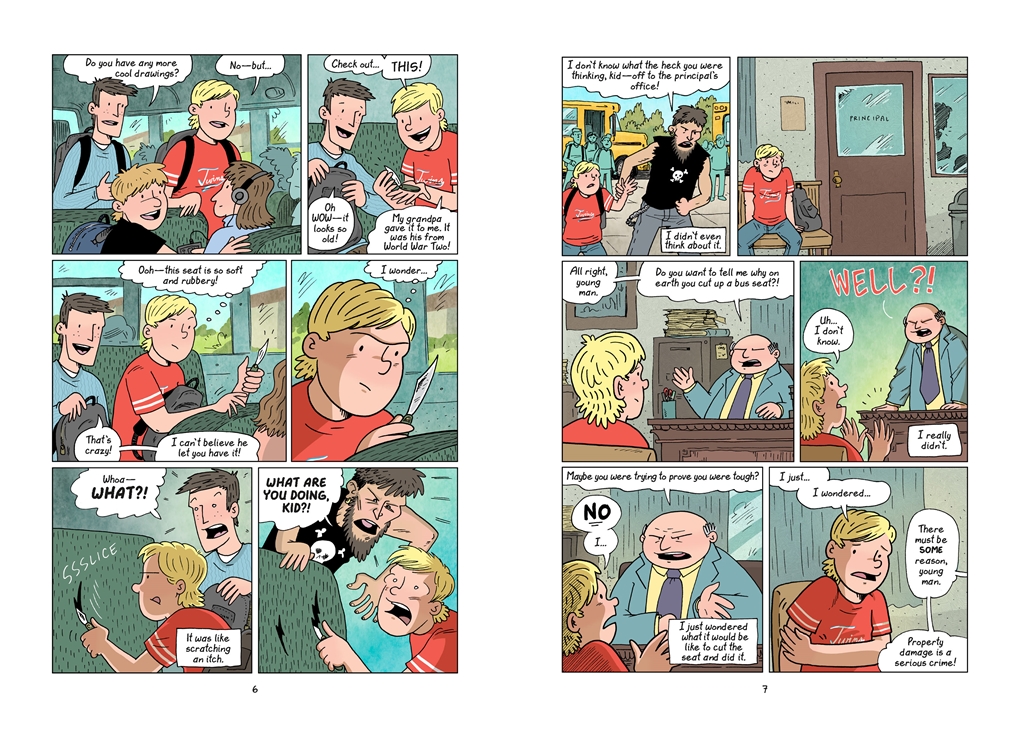
I noticed last weekend that one of my 2022 Reading Challenges, The Monthly Motif Challenge, had for its August theme, "Quick Lit," to read something short. Since I have been immersed in my own Big Book Summer Challenge, all I've read all month (and all summer) have been books with over 400 pages! So, I chose a shorter graphic novel from my shelves to squeeze in. I thoroughly enjoyed Button Pusher by Tyler Page and learned a lot from this intriguing graphic memoir about growing up with ADHD.

Tyler tells his childhood story mostly from the perspective of the age he was at the time, starting at just eight years old. Through a novel-like story, we see that Tyler is a happy, friendly kid who does well in school but is always in constant motion. He gets in trouble in school for fidgeting and not staying in his seat, he gives into impulses and does things that get him into big trouble, without understanding why, and even in the doctor's office, Tyler is moving nonstop, touching and playing with everything in sight. But Tyler is also a sweet kid who enjoys playing video games with friends, building with Legos, and who loves to draw. Visits to his pediatrician start him down the path to an ADHD diagnosis, which was relatively new at the time, and eventually to treatment with Ritalin, as it becomes clear that his behavior is disruptive both at school and at home. Tyler and his family have other issues, as well, though. Money is very tight, Tyler's parents fight constantly, and his dad often loses his temper and screams, hits things, and spanks Tyler. Things get so bad that Tyler starts to spend most of his time either in his room, drawing, or at friends' houses. The story follows Tyler and his family all the way from elementary school to middle school to high school. It ends as Tyler heads off to college to start a new chapter of his life ... though he points out on that last page that his hardest challenges with ADHD were still ahead of him.

Sample page from Button Pusher

On its surface, this is a very enjoyable, beautifully-drawn graphic story of childhood and adolescence, told from a boy's perspective. But there is also so much emotional depth to this memoir, plus fascinating information about ADHD. The colorful panels depicting Tyler's story are interspersed with copies of notes from his pediatrician and a few brief sections of informational graphics, explaining the science behind ADHD, Ritalin, labels, and other related topics. It's the perfect combination of entertainment and education, and I learned a lot while enjoying the story. It actually made me think back to my own childhood classmates and perhaps better understand certain behaviors from them. I'm sure back in my day, some kids (especially boys) were labeled trouble-makers and written off at a young age when they probably had ADHD. The age recommendations from the publisher say 10-14 years old, but I think any kids or teens who have ADHD or know someone who does (probably most kids in school) would benefit from reading this enjoyable book. I hope there's a sequel about his college years!

245 pages, First Second 


This book fits in the following 2022 Reading Challenges:

Mount TBR Challenge

Monthly Motif - Quick Lit

Nonfiction Reader Challenge - Medical Memoir

Diversity Challenge (August mini-challenge: mental health)


Disclosure: I received this book from the publisher in return for an honest review. My review is my own opinion and is not influenced by my relationship with the publisher or author.


Note: This post contains affiliate links. Purchases from these links provide a small commission to me (pennies per purchase), to help offset the time I spend writing for this blog, at no extra cost to you.


Visit my YouTube Channel for more bookish fun!


You can buy the book through Bookshop.org, where your purchase will support the indie bookstore of your choice (or all indie bookstores)--the convenience of shopping online while still buying local!


Or you can order Button Pusher from Book Depository, with free shipping worldwide.

Thursday, August 25, 2022

Fiction Review: The Overstory

Since its release in 2018, I have been hearing rave reviews of The Overstory by Richard Powers, which won the Pulitzer Prize, was short-listed for the Man Booker Prize, and was on lots of Top 10 lists that year. Many of my friends told me what an amazing book it was, as well. It was on my stack for Big Book Summer 2021, but I never got to it. Thankfully, I made it a priority this year, for Big Book Summer 2022, because this novel about trees (and people) is a powerful, engrossing story that is utterly original.

The book is cleverly structured in four parts: Roots, Trunk, Crown, and Seeds. Roots is structured as a series of separate short stories. Each story focuses on a person or family and a tree or trees that are somehow connected to their lives. For instance, the first story is about a Norwegian immigrant in 1800's New York. He proposes to his future wife, an Irish immigrant, one evening while they are picking chestnuts in what was then a time of celebration in a region filled with chestnut trees. After marriage, they move to Iowa, buy five acres of land for a farm, and the man plants some of the leftover chestnuts. One grows into a giant chestnut tree, next to their farmhouse. Over the next 150 years or so, the tree grows (later, a unique sight after all the chestnuts on the East Coast die), as their family grows. Generations grow up, as the tree grows up, and a unique way of documenting the tree's growth is carried on through the family, until Nick, an artist and the great-great-great grandson of the homesteader is left to remember the tree's legacy.

That's just a brief outline of the first story in Roots. There are seven others, each focusing on a person or family somewhere in the U.S. (though sometimes with roots elsewhere) and the tree(s) that affected their lives. Each story is accompanied by a drawing of a branch of the tree. In Part 2, Trunk, the eight people highlighted in Roots, eventually come together on the West Coast, on a mutual mission to save some of our nation's oldest trees from being clear-cut. They are up against formidable forces in their fight, and each person carries his or her own roots, family, memories, and reasons why trees are important. In Crown, things fall apart, and the group separates, each devastated and coping in his or her own way to a tragedy that occurred. At this stage in the novel, they--and the reader--begin to feel that the goal of saving the trees (and the urgency to do so) are hopeless. However, in Seeds, there are glimmers of hope, as different characters each do their own part, and the trees themselves show some resilience.

That long description barely begins to capture the real essence of this book. It's magical, the way these people come together and find each other, in much the same way that trees connect with each other, communicate, and depend on each other. One character in the novel, Patricia Westerford, a hearing-impaired botanist who got her love of nature from her father, studies trees, writes books, and blows away old thinking about forests with ground-breaking research. Her passages provide some facts and science but in a beautiful, engaging way that is intricately connected with her life. It's a book about trees but also about people and mostly about the connections between both. This special novel uniquely combines science, spirituality, relationships, deep characterizations, and even suspense into a beautifully written and completely original story. This is one that will stick with me for a long time.

502 pages, W.W. Norton & Company

Recorded Books

Note: This post contains affiliate links. Purchases from these links provide a small commission to me (pennies per purchase), to help offset the time I spend writing for this blog, at no extra cost to you.


This book fits in the following 2022 Reading Challenges:


Mount TBR Challenge

Alphabet Soup - O

Diversity Challenge

Literary Escapes Challenge - Oregon

Big Book Summer Challenge

Visit my YouTube Channel for more bookish fun!


Listen to a sample of the audiobook here, from the prologue and the beginning of the first story, about the chestnut, and/or download it from Audible.


You can buy the book through Bookshop.org, where your purchase will support the indie bookstore of your choice (or all indie bookstores)--the convenience of shopping online while still buying local!


Or you can order The Overstory from Book Depository, with free shipping worldwide.

Friday, February 04, 2022

Nonfiction Review: Bottle of Lies

Forget Stephen King. In Bottle of Lies: The Inside Story of the Generic Drug Boom, author and investigative journalist Katherine Eban writes about real-life horror scarier than any of King's novels! As sometimes happens, my book group chose this book that I wasn't interested in reading, and as almost always happens, I ended up being glad I'd read it! This engrossing, terrifying nonfiction book opens the door to the generic drug industry's dirty secrets.

Eban begins by taking an up-close look at one of the worst actors in the generic drug industry, Ranbaxy, an Indian company that is, thankfully, no longer in business. She details how the family-run company started and zeroes in on the personal and professional lives of some of the key players. This company was crooked in horrifying, shocking ways, from the top down. Top management willfully and knowingly manufactured medicines with no quality control, completely making up the data to get their drugs approved by the FDA and providing fraudulent data during their rare FDA inspections. One reason she spends so much time focusing on Ranbaxy is because what they did is not unusual in the generic drug industry. Many other companies, especially in India and China, commit similar frauds--making up their data to get approved, hiding test data that shows contaminants or lesser effectiveness, getting their active ingredients from shady companies not in their official records, and more--and they continue to do so. One of the main characters in the book is Dinesh Thakur, an Indian scientist who became an American citizen and worked at Bristol-Myers Squibb in New Jersey, where he witnessed what highly-regulated, conscientious pharmaceutical research and manufacturing looks like. A friend of his, also from India, convinced him to transfer to Ranbaxy, where he and his new wife could be near their families in India and be part of the up-and-coming Indian pharmaceutical industry. Thakur was a good man with a strong moral character, and he could not be a part of what he eventually realized was going on at Ranbaxy. So, he became a whistleblower, which in India often gets you killed, and finally found someone at the FDA who would listen to him. Stunningly, despite all the hard evidence Thakur provided, it took the FDA ten years to finally make Ranbaxy pay--and even then, it was far less consequences than they deserved. From there, the author moves onto other examples and other companies, as well as American doctors and patients discovering their generic drugs didn't work as well as the brand name drugs, though again, no one would listen to them at first. She delves into the inner workings of the FDA and why politics often guides their decisions on approving drugs. Unfortunately, the book does not end on a hopeful note--many of the issues described are still going on.

This book was so disturbing and shocking to me. First, I rely on about 15 different generic medications to help manage my chronic illness. When I finished this book, my husband and I both raced to our laptops to try to figure out where our meds are manufactured (not an easy thing to find out) and whether any of the sketchier companies in the book were involved. Also, I used to do audits similar to those that the FDA inspectors do, though not in the pharmaceutical business. I worked in Quality Management Systems (QMS), and the FDA's Good Manufacturing Practices (which many of these companies are making a joke of) are a type of QMS. The thought of a company I was auditing just completely making up their data and records is unthinkable. It is certainly a fascinating book, but in a "can't look away from the car crash" kind of way. I kept interrupting my husband's reading to tell him horrifying facts. As much as the information terrified me, I had no trouble at all reading the whole book (and fairly quickly). The book is very well-written. because the author focuses on the people involved and tells an immersive, engrossing story that sometimes reads like a legal thriller. Unfortunately, this is a thriller where most of the bad guys got away with their crimes. I will never look at a bottle of generic medication the same again. 

461 pages (though the text ends on page 410; the rest is reference material), Ecco

Reading Challenges:

B in the Alphabet Soup Challenge

Nonfiction Reader Challenge (2 in January - a record for me!) - fit into the category of popular science

Diversity Challenge

India in the Travel the World in Books Challenge

Maryland for the Literary Escapes Challenge

Note: This post contains affiliate links. Purchases from these links provide a small commission to me (pennies per purchase), to help offset the time I spend writing for this blog, at no extra cost to you.

Visit my YouTube Channel for more bookish fun!


Listen to a sample of the audiobook here, narrated by the author, and/or download it from Audible.


You can buy the book through Bookshop.org, where your purchase will support the indie bookstore of your choice (or all indie bookstores)--the convenience of shopping online while still buying local!


Or you can order Bottle of Lies from Book Depository, with free shipping worldwide.